← Back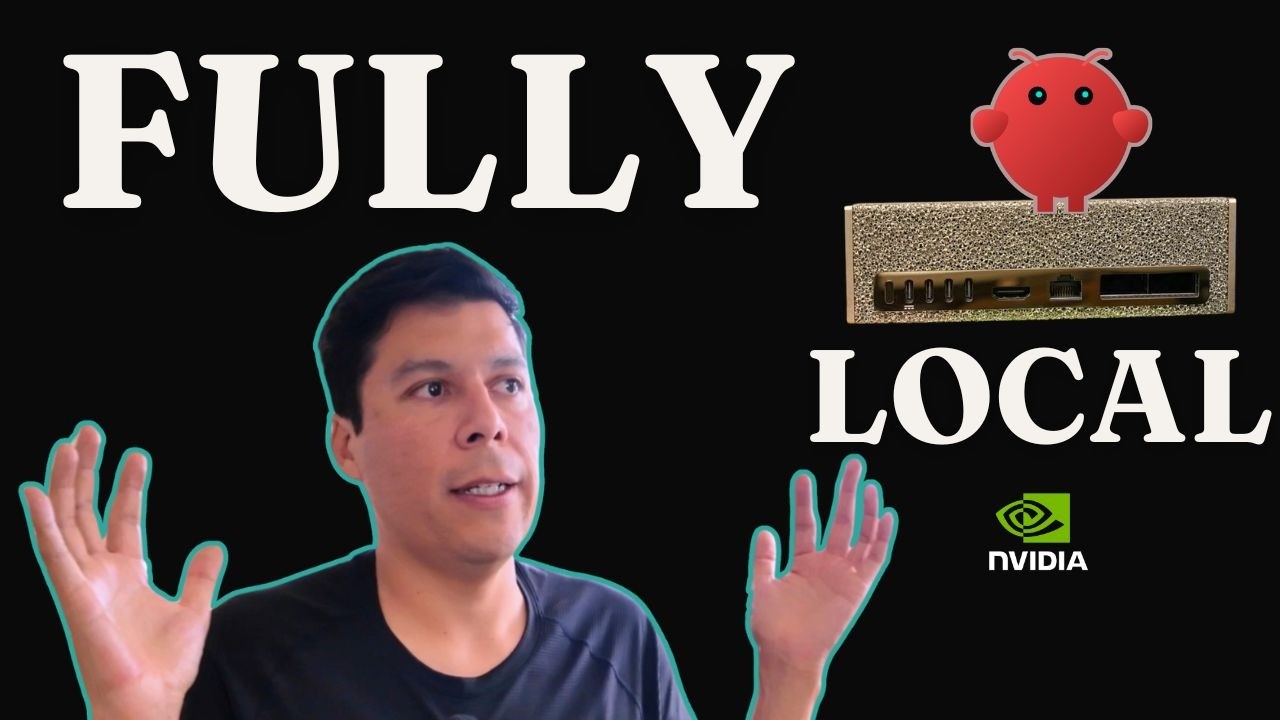
YouTube/Ray Fernando
OpenClaw: Building Local Memory on DGX Spark
View original
local aiknowledge managementai agents
Agent Instructions
agent prompt
// These are key takeaways from “OpenClaw: Building Local Memory on DGX Spark” (source). Use this guide to see how this could fit into our workflow and tell me what could work, what we do differently, and how we might adopt any of this into our current workflow.
# Local Contextual Memory System

## Context
This content describes a multi-layered local AI system designed to centralize, process, and reason over personal data to create a "contextual memory layer." It highlights a practical approach to building a powerful, private, and cost-effective personal knowledge base using local hardware and open-source tools.

## Principles
- **Data Ownership & Privacy:** Prioritize keeping all personal data local to avoid cloud service costs and maintain privacy.
- **Layered Architecture:** Break down complex AI systems into distinct, manageable layers for ingestion, processing, and reasoning.
- **Learning by Doing:** Embrace hands-on implementation as the primary method for understanding complex AI concepts and systems.
- **Cost-Effectiveness:** Leverage local hardware and open-source models to significantly reduce operational costs compared to cloud alternatives.

## Implementation Patterns
- **Multi-Source Data Ingestion:** Collect data from diverse sources like Slack, Google Drive, Notion, meeting transcripts, and chat histories.
- **Vector Database for Semantic Search:** Use NV Embed V2 for text embeddings and Qdrant for storing meaning vectors to enable semantic search.
- **Graph Database for Entity & Relationship Mapping:** Implement GLINER for entity extraction (people, projects, decisions) and Falcor DB for storing and querying these relationships.
- **Local LLM for Reasoning:** Deploy a large language model (e.g., Quen3 30B) locally on powerful hardware (like NVIDIA DGX Spark) for context retrieval and grounded answers.
- **Docker for Infrastructure Management:** Containerize databases (Qdrant, Falcor) and other services (WhisperX, VLM) using Docker Compose for easy setup and management.
- **Agent-Assisted Development:** Utilize AI coding assistants (e.g., Cursor) for tasks like environment setup, command execution, and research.

## Configuration Suggestions
- **Hardware:** Consider an NVIDIA DGX Spark or a high-end local PC with a powerful NVIDIA GPU (e.g., RTX 4090/5090, Blackwell systems) for running local LLMs and other compute-intensive tasks.
- **Speech-to-Text:** Use WhisperX with diarization for accurate speech-to-text transcription and speaker identification in meeting notes.
- **LLM Deployment:** Deploy VLM (e.g., Averac's MVFP4-enabled image) for serving local LLMs efficiently.
- **Network Setup:** Use a secure VPN (e.g., Tailscale) to connect different local machines and services securely.
- **Python Environment:** Manage Python dependencies and virtual environments using tools like `uv`.

## Warnings
- **Token Costs:** Be mindful of token usage with cloud-based AI services; local solutions can drastically reduce these costs.
- **Hardware Requirements:** Running powerful local LLMs and vector/graph databases requires significant RAM and GPU resources.
- **Complexity:** Building and maintaining a custom local AI system can be complex and requires a deep understanding of various components.
- **AI Slop/Bot Behavior:** Be vigilant against AI-generated content or bot-like interactions in online communities, as they can dilute meaningful discussions.
Human Summary
- Local AI for Personal Knowledge Management: The speaker is building a local AI system to centralize and reason over all personal data (Slack, Google Drive, Notion, meeting transcripts, chat histories) using an NVIDIA DGX Station (Spark). This aims to avoid high monthly costs of cloud-based solutions and gain full data ownership.
- Multi-Layered Architecture: The system involves a multi-layered approach:
- Layer 1 (Data Ingestion): Collects data from various sources (audio, documents, messages).
- Layer 2 (Processing & Indexing): Uses Whisper for speech-to-text, NV Embed V2 for converting text to meaning vectors stored in Qdrant (for semantic search), and GLINER with Falcor DB for entity extraction (people, projects, decisions) and relationship mapping.
- Layer 3 (Reasoning): Employs a local LLM (Quen3 30B) running on the Spark to retrieve context and provide grounded answers.
- Hardware & Performance: The NVIDIA DGX Spark, despite having 128GB of shared memory, is powerful enough to run these local models, including a VLM with MVFP4 support, achieving 60 tokens/second throughput for the Quen3 30B model. This demonstrates the viability of high-performance local AI.
- Cost Savings & Data Ownership: The primary motivation is to eliminate the significant monthly costs (potentially $400-$1000+) associated with cloud services for indexing and querying personal data, while also retaining complete control and privacy over one's information.
- Learning by Doing: The project is framed as a hands-on learning experience to deeply understand memory systems, graph databases, vector databases, and the practicalities of running large language models and other AI components on local hardware.
- Inspiration from Industry: The architecture is inspired by systems used in call centers (e.g., Pulse HQ) for real-time transcription, entity extraction, and context graph creation, highlighting the potential for real-world applications.
- Agent-Assisted Development: The speaker leverages AI agents (Cursor with Opus Max) to assist in the development process, such as setting up Docker containers, verifying installations, and researching technical details, showcasing an effective developer workflow.